Key takeaways
- Laser engraving is the most durable method — it removes the coating instead of adding ink — but it produces a single tone.
- Screen printing is the most economical choice for 1–3 flat spot colours at volume; each colour needs its own screen.
- UV printing handles full colour, gradients and fine detail on the body.
- Heat transfer covers most of a straight body with a full-colour, all-over design.
- Water decal is the method for detailed colour artwork on glass and ceramic.
The five methods at a glance
| Method | Colours | Best on | Durability | Choose it when |
|---|---|---|---|---|
| Laser engraving | One tone (the metal or base colour shows through) | Powder-coated and painted stainless steel, titanium, metal rings and lids | Permanent | You want a premium, dishwasher-proof mark |
| Screen printing | 1–3 spot colours, matched to Pantone | Straight or gently tapered bodies of steel, Tritan and plastic | High with proper curing | Flat logos in larger quantities |
| UV printing | Full colour (CMYK + white) | Steel, plastic and glass bodies | Good; hand washing extends life | Gradients, photos, many colours, small runs |
| Heat transfer | Full colour, all-over | Straight bodies with a suitable coating | Good | Patterns and campaign artwork that wrap the body |
| Water decal | Full colour, very fine detail | Glass and ceramic | High after firing | Mugs, glass tumblers and gift sets |
1. Laser engraving
A laser removes a thin layer of coating — usually powder coat or paint — and exposes the steel underneath. On a black powder-coated tumbler this gives a crisp silver logo; on bare stainless steel it creates a darker, tone-on-tone mark. Because nothing is added to the surface, there is nothing to peel, fade or wash off.
- Strengths: permanent, premium look, no colour matching needed, very sharp detail.
- Limits: one tone only; the colour is decided by the coating and the metal, not by your Pantone.
- Typical use: corporate gifts, employee programmes, hospitality carafes, titanium and other premium bottles.
2. Screen printing
Ink is pushed through a fine mesh screen onto the body, one colour at a time. Each colour needs its own screen and set-up, so a one-colour logo is the most economical and every extra colour adds cost. In return, screen printing gives solid, opaque spot colours that can be matched to your brand palette.
- Strengths: strong, opaque colour; accurate Pantone matching; low cost per piece at volume.
- Limits: best for 1–3 colours; gradients and photographs are not possible; print area is limited on strongly tapered bodies.
- Typical use: promotional water bottles, Tritan bottles, event giveaways.
3. UV printing
A UV printer jets full-colour ink straight onto the body and cures it instantly with ultraviolet light. Because it works from a digital file, there are no screens: gradients, photographs, fine text and many colours cost the same to print. A white under-layer makes colours vivid on dark bodies.
- Strengths: unlimited colours, photographic detail, ideal for small runs and multiple designs.
- Limits: a slightly raised surface; it lasts best with hand washing.
- Typical use: multi-colour logos, personalised designs, sample runs.
4. Heat transfer
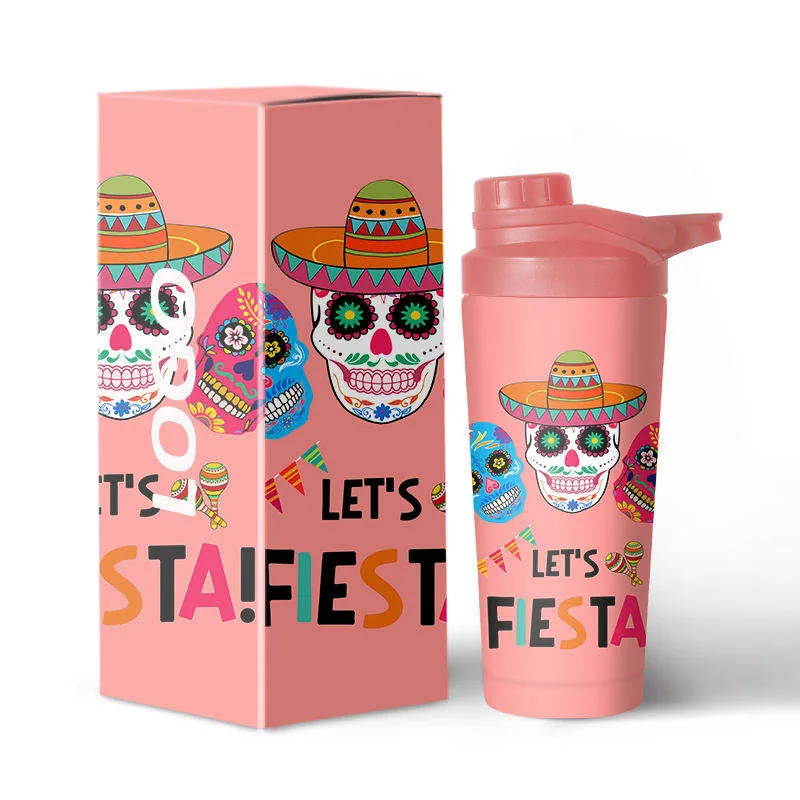
The design is printed onto a transfer film and then fused onto the body with heat and pressure. It can cover most of a straight body, which makes it the method of choice for all-over patterns, seasonal campaigns and full-wrap artwork — for example on a 40 oz car cup.
5. Water decal
A printed decal is slid onto glass or ceramic and fired, so the design bonds with the surface. It is the standard method for detailed, multi-colour artwork on ceramic mugs and glass, and it holds up well to daily use once fired.
How to choose: a quick decision guide
- One-colour logo on steel or titanium? Laser engraving.
- Two or three flat colours and a large quantity? Screen printing.
- Gradients, photos or many colours? UV printing.
- A design that wraps around the whole body? Heat transfer.
- Glass or ceramic with colour artwork? Water decal (or UV on glass).
Preparing artwork that prints well
- Send vector files (AI, EPS or PDF with outlined fonts). PNG files are fine for UV and heat transfer if they are high resolution.
- Give Pantone references for screen printing, and say which colours must match exactly.
- Keep very fine lines and very small text to a minimum — they may close up on curved bodies. We flag this on the digital proof.
- Tell us the logo position and size. Tapered bodies, handles and grip sleeves reduce the printable area.
What drives the cost
- Number of colours (screen printing) and number of print positions.
- Set-up per design — screens, jigs and colour matching.
- Quantity — set-up is spread over more pieces as volume grows.
- Print area — full-wrap prints take more material and time than a small logo.
From artwork to production
Send your artwork and we return a free digital proof showing position, size and colours. Stock samples ship in about a week, and logo samples follow your artwork approval. Standard orders ship about 20 days after sample approval, with photos of the first finished pieces for your sign-off. See the full OEM & ODM process.
Frequently asked questions
Which logo method lasts longest in a dishwasher?
Laser engraving, because it removes the coating rather than adding ink. Fired water decals on ceramic and glass are also very durable. Printed logos last longest with hand washing.
Can I get a full-colour logo on a stainless steel bottle?
Yes. UV printing prints full colour, gradients and photos directly on the body, and heat transfer can cover most of a straight body.
Why does every extra colour cost more in screen printing?
Each colour needs its own screen, set-up and print pass, so cost rises with the number of colours. UV printing has no per-colour set-up.
Do I get a proof before production?
Yes. We send a free digital proof first, then a physical sample on request before mass production.